Ginger. A bit slow.

Monday, October 02, 2006

Ginger news, part one

Ouch! That hurt.

Yes, that's right. While we may have special powers, ginger people can still hurt. In fact, it seems that we can hurt a lot more than non-gingers. I don't really see how that's fair, but it does at least mean that we're sensitive, no matter what people may say.

Dr Edwin Liem, from the University of Louisville, Kentucky, recently found that ginger women between the age of 19 and 40 are more likely to undergo a heightened level of autonomic response when receiving the same amount of an inhaled anaesthetic as a non-ginger test group.

It is believed that mutations within the melanocortin 1 receptor responsible for ginger hair could also be at the root of the increased sensitivity to pain.

This really doesn't seem fair? Have I not already had to suffer enough for my hair?
Famous ginger people, part one

There's been lots of famous ginger people throughout history. It's good to know that these role models exist, I can look up to them & dream about how I could have maybe been as well known as they once were. If I ever get to set up my own country (that's my other dream), I will build statues to some of the famous ginger people, so that others can be as inspired as I have been.

It would be fun to learn more about these famous ginger people. Let's start with a sporting hero to inspire all those ginger footballers that have important European qualfying games next week.

Edson Arantes do Nascimento is one of the most famous footballers in the world. He was born in Três Corações, Brazil, in 1940 and went on to win the World Cup three times. He is better known as Pelé. He wasn't ginger.

However, Gary Doherty, born in Co. Donegal, Ireland, in 1980, is ginger. He's also better known, in some circles at least, as the Ginger Pelé. He started his career with Luton Town, before moving to Tottenham Hotspur for £1 million - more money than was owned by the entire ginger population of the world at the time of the other Pelé's birth. He made his first appearance for Tottenham during a 3-1 defeat against Manchester United. Following a series of injuries & the occasional calamitous own goal, he was sold to Norwich City for 31p at the beginning of the 2004/2005 season. Norwich finished the season in 19th place and were relegated from the Premiership.

The Ginger Pelé has never won the World Cup.

Ginger things, part one

I'm ginger. I like beer. Beer is almost like ale. So surely that means that ginger ale is one of the best things in the world. At least it would be, if it had any alcohol in it. But that doesn't stop you from using it as a mixer. Now anything can be made to be that little bit ginger. But where does it come from? Who was the evil genius (or gingerous as I like to call him) that allowed us to spread the ginger quite so easily? Let's find out, shall we?

Apparently the first ginger ales were made in Ireland, in the 1850s. That's, like, a long time ago. It's worth noting here that there are proportionally more ginger people in Ireland than in any other part of the world - except maybe Middlesbrough. I think that I would like Ireland. Maybe I should move there someday.

However, the 'modern' version of ginger ale was invented by a Canadian pharmacist called Jon McLaughlin in 1890. I don't think that there are that many ginger people in Canada, so he was probably treated like a king back in the day - even before he started to brew his godly elixir, which he called McLaughlin Belfast Style Ginger Ale. That sounds good, doesn't it?

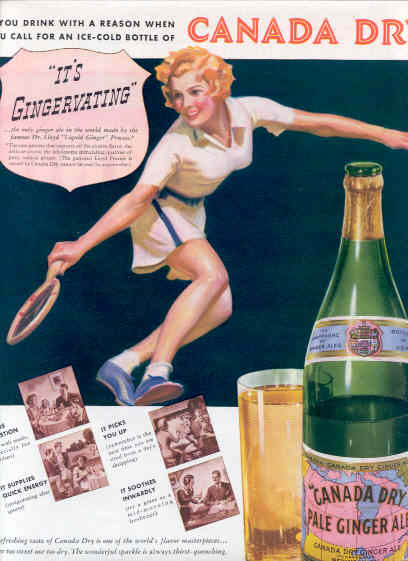
However, once he was a success, McLaughlin tried to shun the very ginger that he had once loved. In 1907 he found a way to lighten the colour of his ale (making it, boo hiss, less ginger) in order to sell it to people who were scared on becoming ginger should they take as little as a sip of the drink. This drink was patented as Canada Dry Pale Dry Ginger Ale, and explains to this day why so many ginger people also have very pale skin.